Orlando Housing Market Forecast: What to Expect in the Second Half of 2026

Orlando Housing Market Forecast: Second Half of 2026
See what buyers and sellers can expect from the Orlando housing market in late 2026, including home prices, inventory, mortgage rates, and local trends.
If you are thinking about buying or selling a home in Orlando before the end of 2026, the market is giving you something that was difficult to find just a few years ago: time to make a more calculated decision.
The second half of 2026 is shaping up to be neither a dramatic housing boom nor a widespread housing crash. Instead, buyers and sellers are navigating a more balanced environment influenced by mortgage rates, growing inventory, modest price movement, longer selling times, and major differences between individual Central Florida communities.
National housing activity also points toward a slower, more measured market. The National Association of REALTORS® reports that existing-home sales declined 1.7% in July 2026, while year-to-date sales were still 2.4% higher. That combination suggests a market that is moving, but not accelerating into another buying frenzy.
For Orlando buyers and sellers, that makes local data more important than national headlines.
Where the Orlando Housing Market Stands Right Now
The latest available Orlando Regional REALTOR® Association housing market report provides an important starting point for understanding what may happen during the remainder of 2026.
In June, Orlando-area home sales increased for the fifth consecutive month. Overall sales reached 2,929, up 8% from May. The median home price increased from $407,002 in May to $416,308 in June, while homes spent an average of 62 days on the market. Inventory stood at 11,924 properties, representing approximately 4.1 months of supply.
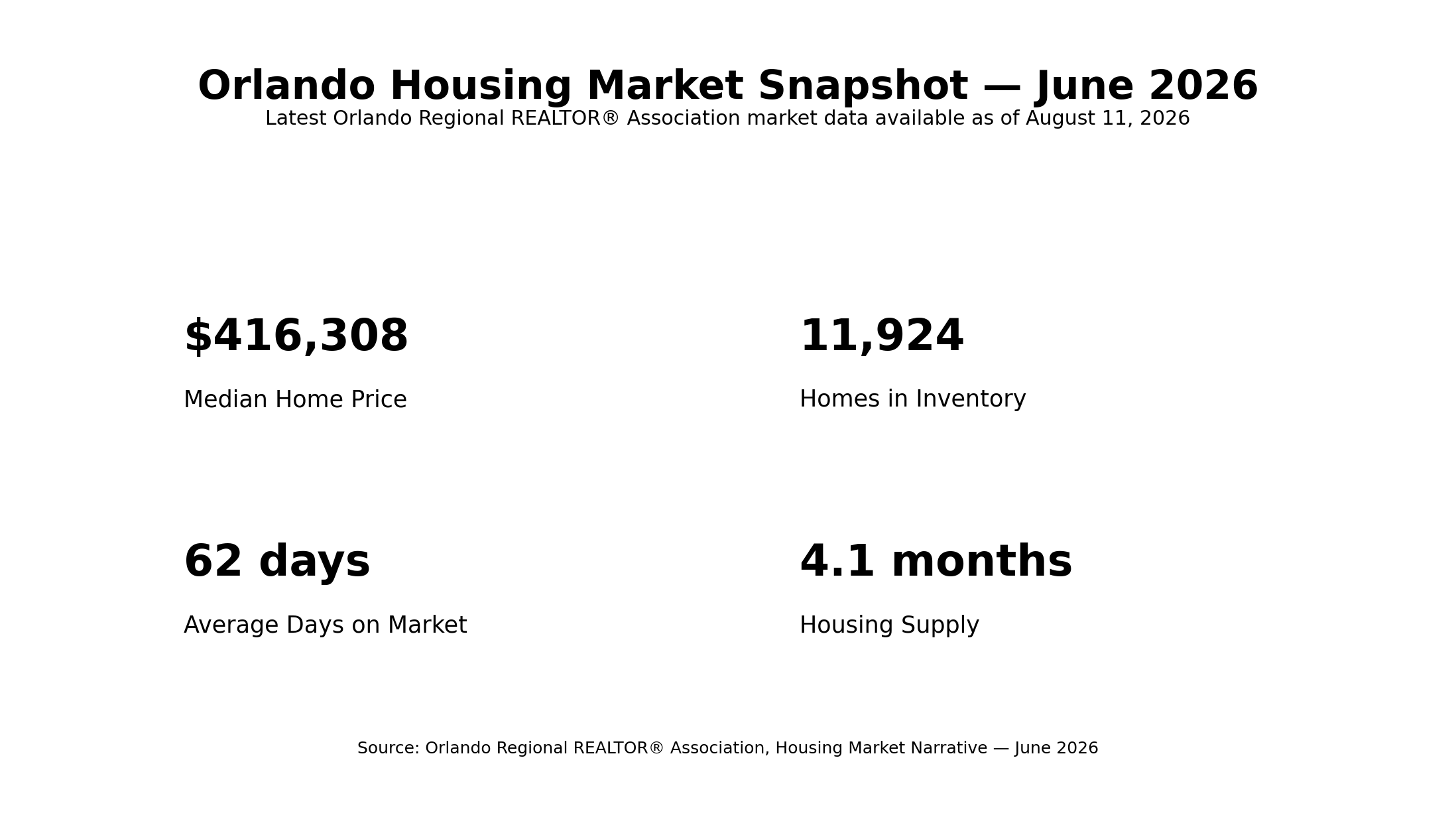
Single-family homes and attached housing also showed a significant price difference. ORRA reported a June median price of $451,922 for single-family homes, compared with $301,057 for condos and townhouses.
There is an important detail behind those numbers. Beginning with its April 2026 reports, ORRA expanded the residential market area reflected in its monthly reporting to include Orange, Osceola, Lake, Seminole, and Volusia counties. Therefore, consumers comparing today's statistics with older reports should be careful about treating every figure as a direct apples-to-apples comparison with the City of Orlando alone.
That distinction is also why a homeowner in Lake Nona can have a very different experience from someone selling a downtown condo, a house in Winter Garden, a property in Sanford, or a home closer to Kissimmee.
Mortgage Rates Will Continue to Control Buying Power
Mortgage rates remain one of the biggest variables for the Orlando housing market in the second half of 2026.
According to Freddie Mac's Primary Mortgage Market Survey, the average 30-year fixed mortgage rate was 6.69% on August 6, 2026, compared with 6.66% the previous week.
That matters because buyers typically shop according to monthly payment rather than purchase price alone. Even a relatively small change in interest rates can change how much house a buyer can comfortably afford.
Consumers hoping for an immediate return to the ultra-low mortgage rates of several years ago may want to temper those expectations. Fannie Mae's July 2026 Housing Forecast projected an average 30-year mortgage rate of approximately 6.4% for both the third and fourth quarters of 2026. Its forecast also called for relatively modest national home-sales growth rather than an explosive rebound.
For Orlando, this creates an interesting dynamic. If rates move meaningfully closer to 6%, some sidelined buyers could return and competition could increase. If rates remain in the mid-to-upper 6% range, buyers are likely to stay payment-conscious and selective, putting more pressure on sellers to price correctly.
In other words, waiting for dramatically lower rates is not a guaranteed strategy. Buyers should evaluate a home based on what works financially today while preserving the possibility of refinancing later if rates improve.
More Inventory Is Giving Orlando Buyers Breathing Room
The Orlando market is no longer operating under the extreme inventory shortage that characterized the hottest pandemic-era years.
With 11,924 homes in inventory and approximately 4.1 months of supply in June, buyers now have more opportunity to compare properties, evaluate condition, review costs, and negotiate before making a decision. ORRA considers six months of supply a benchmark for a balanced market, so the region was still below that threshold in June.
That means it would be inaccurate to describe every part of Orlando as a full buyer's market. But it would also be inaccurate to assume sellers still hold unlimited leverage.
Homes taking an average of 62 days to sell create a very different negotiating environment from one in which buyers had to submit an offer immediately after a property appeared online.
For a buyer, that can mean opportunities to request repairs, closing-cost assistance, rate-buydown contributions, or a more favorable purchase price when a property has been sitting on the market.
For sellers, the message is equally important: the market is increasingly sensitive to price.
Orlando Home Prices Look More Stable Than Explosive
The latest numbers do not support the idea of a widespread Orlando housing crash, but they also do not suggest that homeowners should expect another period of double-digit annual appreciation.
ORRA reported a June 2026 median price of $416,308, compared with $409,631 in June 2025—an increase of roughly 1.6%.
National forecasts point in a similar direction. Fannie Mae's July outlook projected comparatively modest home-price growth during 2026 rather than the extraordinary appreciation seen earlier in the decade.
This may actually create a healthier market.
Slower appreciation can give wages and household finances more time to catch up, while homeowners who purchased years ago may still benefit from significant accumulated equity. At the same time, sellers must be careful not to price a property solely according to what a neighbor achieved during a substantially different market.
The most useful comparable sale in late 2026 may be one that closed recently—not one from the market's peak.
Orlando's Population Growth Still Supports Long-Term Housing Demand
One reason Central Florida continues to attract attention is population growth.
According to the U.S. Census Bureau's latest metropolitan population estimates, the Orlando-Kissimmee-Sanford metro area added approximately 37,690 residents between July 2024 and July 2025, reaching an estimated population of about 2.96 million. Orlando ranked among the country's top 10 metropolitan areas for numeric population growth during that period.

Population growth does not guarantee higher home prices every year. Mortgage rates, employment, construction, insurance expenses, property taxes, and affordability can all influence short-term housing demand.
But continued household growth gives Central Florida an important underlying source of housing demand that buyers, sellers, and long-term property owners should keep in mind.
New Construction Could Be One of the Biggest Competitors for Resale Sellers
Another factor Orlando sellers should watch is competition from newly built homes.
At the national level, builders have increasingly used incentives to attract payment-conscious buyers. The National Association of Home Builders reported that 63% of builders were using sales incentives in July 2026, while 37% reported cutting prices.
Those are national figures rather than Orlando-specific numbers, but they matter in a region where new-home communities form a meaningful part of the housing landscape.
A resale homeowner may therefore be competing not only with the house down the street but also with builders offering financing incentives, closing-cost assistance, upgrades, or rate buydowns.
That makes preparation, presentation, condition, and pricing especially important for sellers during the second half of the year.
Orlando's Condo Market Requires Extra Due Diligence
Condo buyers should look beyond the unit's purchase price.
Florida's condominium regulations have increased the importance of understanding an association's reserves, inspections, financial obligations, and possible assessments. Under Florida Statute 718.112, qualifying residential condominium buildings that are three habitable stories or higher are subject to structural integrity reserve study requirements, with reserve funding obligations tied to covered building components.
For buyers evaluating an Orlando condo, this means reviewing association financial documents, reserve studies, meeting minutes, existing assessments, insurance information, and anticipated repairs can be just as important as inspecting the unit itself.
For condo sellers, being prepared with organized association documentation can help prospective buyers understand the property's true monthly and long-term ownership costs.
What Orlando Homebuyers Should Expect Through the End of 2026
The strongest position for a buyer in today's Orlando real estate market is flexibility.
Rather than focusing only on the asking price, consider the full cost of ownership. Mortgage payments, homeowner's insurance, property taxes, HOA or condo fees, maintenance, and potential assessments should all be incorporated into the decision.
Buyers should also compare resale properties with new construction carefully. A new home with a higher advertised price could potentially have attractive financing incentives, while an existing home might offer more room to negotiate the purchase price. The better option depends on the complete financial package rather than the sticker price alone.
Most importantly, increased days on market mean buyers can often be more analytical than they could during the market's most competitive years. That does not mean every desirable house will sit unsold—well-priced properties in sought-after areas can still attract strong interest—but shoppers may have more leverage when a listing is overpriced or needs significant updates.
What Orlando Home Sellers Should Expect Through the End of 2026
Sellers should enter the second half of 2026 with realistic expectations about both pricing and timing.
With Orlando-area properties averaging 62 days on market in June, a home that does not receive multiple offers during its first weekend is not necessarily failing. At the same time, sitting significantly above comparable sales can become expensive because buyers have more alternatives.
Pricing close to current market value can help generate attention early, while overpricing and repeatedly reducing the price later may make buyers wonder why the property has remained available.
Condition also matters more when inventory expands. Small repairs, professional photography, strong online presentation, cleanliness, curb appeal, and accurate pricing can make the difference between a listing that receives serious interest and one buyers continually skip.
Sellers should also prepare for negotiations. A buyer asking for a closing-cost credit or repair does not necessarily mean the deal is unattractive. The final net proceeds and overall terms matter more than winning every individual negotiation point.
The Orlando Market Is Becoming Hyperlocal Again
One of the most important Orlando real estate trends for 2026 is that there is no longer one simple description that fits every property.
A downtown Orlando condo competes in a different market from a newer single-family home near Lake Nona. Winter Garden and Horizon West can have a different combination of new construction and resale competition, while Seminole County and areas around Sanford offer another mix of housing age, lot sizes, amenities, and buyer priorities. Osceola County adds yet another layer to the broader Orlando market.
Even within the same ZIP code, updated homes, properties with desirable lots, homes needing major repairs, and properties carrying substantial HOA costs may experience dramatically different levels of demand.
That is why national forecasts—and even metro-wide statistics—should be treated as context rather than a substitute for neighborhood-level analysis.
Will the Orlando Housing Market Crash in 2026?
Based on current data, a broad Orlando housing crash is not the most obvious scenario for the remainder of 2026.
Local sales have been increasing month over month, the June median price was modestly higher than a year earlier, and Central Florida continues to add population. At the same time, mortgage rates remain high enough to restrain affordability, and buyers have significantly more time and choice than during the most competitive years.
That combination points more toward normalization and greater negotiation than either a dramatic boom or collapse.
Individual properties and neighborhoods can still experience price declines, especially when a home is overpriced, requires substantial work, faces high ownership costs, or competes with abundant new construction. Conversely, desirable homes priced appropriately can still sell quickly.
What Could Change the Market Before the End of the Year?

Mortgage rates remain the variable most likely to change the pace of the market quickly.
If rates move materially lower, affordability would improve and some buyers who have been waiting could re-enter the market. That could shorten selling times and reduce negotiating leverage.
If rates remain around today's levels, late-2026 Orlando real estate will likely continue rewarding buyers who negotiate carefully and sellers who price realistically.
If borrowing costs rise further, affordability could weaken again, putting additional pressure on sellers and increasing the importance of concessions.
That is why trying to predict one perfect moment to buy or sell is rarely as useful as building a strategy around your own financial circumstances.
Final Outlook for the Orlando Housing Market in Late 2026
The Orlando housing market forecast for the second half of 2026 can be summarized as a transition toward a more deliberate marketplace.
Inventory has improved. Homes are taking longer to sell. Price growth has become more moderate. Mortgage rates remain a major affordability hurdle. New-home builders are competing aggressively for buyers, and Central Florida's continued population growth provides a longer-term source of housing demand.
For buyers, the opportunity is greater choice and negotiating power.
For sellers, success is increasingly dependent on accurate pricing, preparation, and understanding the competition.
And for anyone trying to decide what happens next, the most useful information will not simply be whether "the U.S. housing market" is rising or falling. It will be what buyers are actually paying for comparable homes in your part of Orlando right now.
That is what makes the second half of 2026 especially interesting: the market is becoming less about chasing headlines and more about making smart, property-specific decisions based on current local data.