Think You Need 20% Down To Buy in Orlando? Think Again

What Buyers Need to Know in 2026
Orlando Down Payments Are Getting Smaller: What Homebuyers Need To Know in 2026
For many aspiring homeowners, the down payment feels like the biggest obstacle between renting and receiving the keys to a home. That challenge can seem especially intimidating when buyers assume they must save 20% of a property’s purchase price before speaking with a lender.
Fortunately, 20% is not a universal homebuying requirement.
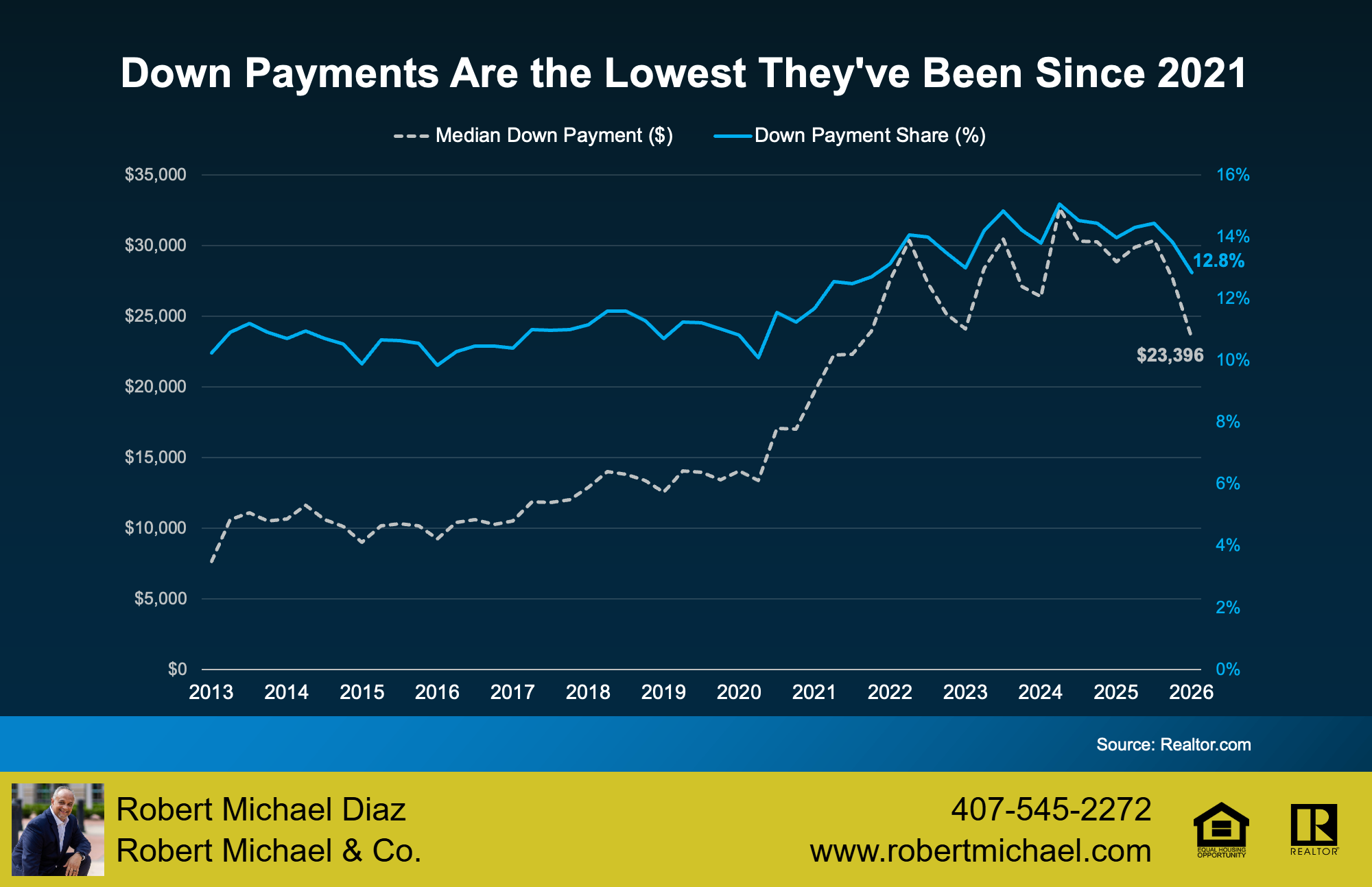
Recent national housing data shows that down payments have been trending lower. In the first quarter of 2026, the median down payment fell to approximately $23,400, or 12.8% of the purchase price. That was the lowest dollar amount recorded since the third quarter of 2021 and represented a 19% decline from one year earlier. Down payments in the South averaged an even lower 11.1% during the same period.
That does not mean every buyer should automatically make the smallest down payment possible. It does mean Orlando homebuyers may have more financing options than they realize. and waiting until they have saved 20% could be unnecessary.
Here is what the changing down-payment landscape means for buyers considering a home in Orlando, Florida.
Why Are Homebuyers Making Smaller Down Payments?
The decline in down payments is connected to several changes taking place across the housing market.
During the highly competitive market of 2021 and 2022, buyers often increased their down payments to strengthen their offers, reduce their loan balances and compete against cash buyers. Rapidly rising prices also pushed the dollar amount of a typical down payment higher.
Conditions have gradually shifted. National housing inventory has increased, price growth has moderated in many markets and some sellers have become more willing to negotiate. Government-backed mortgages have also taken on a larger role. FHA and VA loans together accounted for more than one-third of purchase mortgages in early 2026, helping more buyers enter the market without making exceptionally large down payments.
The latest numbers should still be viewed in context. Although down payments are lower than their recent peak, they remain above pre-pandemic levels. In the first quarter of 2019, the typical down payment was $12,500, or 10.7% of the purchase price.
In other words, the upfront cost of buying a home has not suddenly become inexpensive. Buyers simply have more reasons to investigate alternatives to the traditional 20% benchmark.
What the Orlando Housing Market Means for Your Down Payment
National trends provide useful context, but your actual down payment will depend on Orlando home prices, your loan program and the property you choose.
The Orlando Regional REALTOR® Association reported an overall median home price of $416,308 in June 2026, up from $407,002 in May. The median price for a single-family home was $451,922, while the median for condos and townhouses was $301,057.
Orlando also had 11,924 homes in inventory and approximately 4.1 months of housing supply in June. Homes spent an average of 62 days on the market. ORRA considers six months of supply the benchmark for a balanced market, so Orlando was not fully balanced, but buyers generally had more time and more choices than they did during the fastest-moving pandemic-era market.
Using Orlando’s June 2026 overall median price of $416,308, different down-payment percentages would look approximately like this:
| Down Payment Percentage | Estimated Down Payment |
|---|---|
| 3% | $12,489 |
| 3.5% | $14,571 |
| 5% | $20,815 |
| 10% | $41,631 |
| 20% | $83,262 |
Estimates are based on an Orlando home price of $416,308. Figures do not include closing costs, inspections, insurance, property taxes, mortgage insurance, or other homebuying expenses.
These figures are illustrations based on the reported median price, not quotes for a particular mortgage. They also do not include closing costs, prepaid insurance, inspections, moving expenses or cash reserves.
The difference between 5% and 20% down on a median-priced Orlando home is more than $62,000. For a qualified buyer, that difference could determine whether purchasing is possible this year or remains years away.
One of the biggest misconceptions about homeownership is that you have to come up with the entire down payment on your own. In reality, thousands of down payment assistance programs are available, yet many eligible buyers never take advantage of them.
According to research from the Urban Institute and Down Payment Resource, nearly 44% of recent homebuyers in the 10 largest U.S. metro areas qualified for a down payment assistance program. Even so, many purchased their homes without ever using the help they were eligible to receive (see chart below).
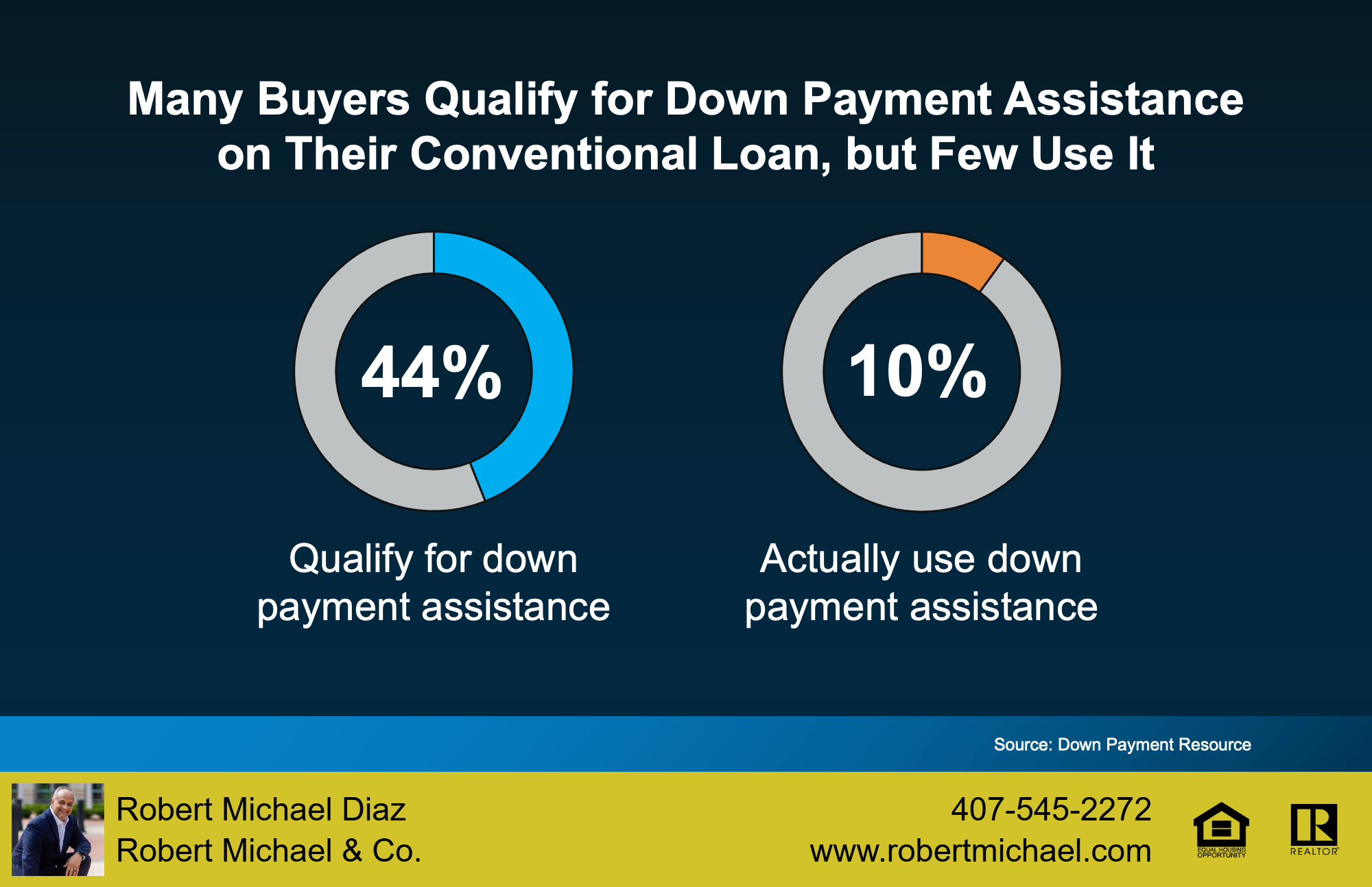
Another common myth is that these programs are only for first-time buyers or low-income households. While many programs are designed with first-time buyers in mind, the requirements are often more flexible than people expect.
Here are a few facts worth knowing:
More than 2,600 down payment assistance programs are available nationwide.
About 62% are geared toward first-time homebuyers.
The other 38% don't require you to be a first-time buyer, so previous homeowners may still qualify.
Nearly 62% of these programs are available to households earning $100,000 or more per year.
Orlando Buyers May Have Several Low-Down-Payment Options
The right mortgage is based on much more than the minimum down payment. Credit history, income, debt, military eligibility, property location and occupancy plans can all affect which program is available.
However, the following options illustrate why buyers should not assume they need 20% down.
Conventional mortgages with as little as 3% down
Qualified borrowers may be able to obtain a conventional mortgage with a down payment as low as 3%. Fannie Mae’s HomeReady program is one example designed to provide lower-down-payment financing for eligible borrowers. Some conventional 3% options have income limits or first-time-buyer requirements, while others depend on a lender’s underwriting rules.
A conventional mortgage may require private mortgage insurance when the down payment is below 20%. PMI increases the monthly housing expense, but it may eventually be removable after the borrower builds sufficient equity and satisfies the applicable requirements.
FHA mortgages with 3.5% down
An FHA-insured mortgage may permit a down payment as low as 3.5% for qualified borrowers. FHA financing can be useful for buyers who have limited savings or who do not meet the credit requirements of certain conventional programs. FHA loans include mortgage insurance, so buyers should compare both the upfront cost and long-term monthly expense.
On an Orlando home priced at $416,308, a 3.5% down payment would be approximately $14,571. That is significantly less than the $83,262 represented by a 20% down payment.
VA loans for eligible borrowers
Eligible veterans, active-duty service members and certain surviving spouses may be able to purchase with no down payment through a VA-backed mortgage, provided the purchase price does not exceed the home’s appraised value and the lender’s requirements are met. VA loans also do not require monthly private mortgage insurance, although a funding fee may apply to borrowers who are not exempt.
USDA financing in eligible areas
USDA Rural Development’s guaranteed loan program can provide 100% financing to qualified buyers purchasing eligible properties in designated areas. Although central Orlando is unlikely to meet rural-property requirements, some communities outside the urban core may qualify. Income and property-location restrictions apply.
A lender familiar with Central Florida can check an address against the current eligibility map before you make an offer.
Down Payment Assistance in Orange County
Buyers should also investigate local assistance rather than relying exclusively on their personal savings.
Orange County’s Homebuyer Down Payment Assistance Program provides funding for eligible first-time homebuyers purchasing a new or existing home in Orange County. As of May 2026, the program lists potential assistance of:
Up to $70,000 for eligible very low-income households
Up to $40,000 for eligible low-income households
Up to $10,000 for eligible moderate-income households
The amount is based on household income and size. Applicants must complete an approved pre-purchase homebuyer education program and secure a first mortgage. The county publishes household income limits and an application process on its official program page.
This assistance could potentially cover part of a buyer’s down payment or closing-related expenses, depending on the program agreement. Qualification is not automatic, and buyers should confirm current funding, property restrictions, repayment terms and application timelines before including assistance in their purchase plan.
An important practical point is that down payment assistance often takes additional coordination. Buyers should discuss the program with a participating lender before touring homes so that financing requirements do not delay an offer or closing.
Is Making a Smaller Down Payment Always the Best Choice?
A low-down-payment mortgage can help someone purchase sooner, but the minimum allowed amount is not necessarily the best amount for every buyer.
A smaller down payment generally results in a larger mortgage balance. That can increase the principal-and-interest payment and may add mortgage insurance. Starting with less equity can also leave a homeowner more exposed if property values decline or if the home must be sold shortly after purchase.
A larger down payment can reduce the loan balance, lower the monthly payment and potentially improve financing terms. Reaching 20% on a conventional mortgage may eliminate the need for PMI.
However, putting every available dollar into the house can create another problem: insufficient reserves.
Florida homeowners need to plan for insurance, property taxes, potential homeowners association dues, maintenance and unexpected repairs. Buyers may also need money for moving, furniture, utility deposits and immediate improvements. Fannie Mae recommends considering the full set of upfront and ongoing costs rather than evaluating affordability through the down payment alone.
A buyer who puts 10% down and retains a healthy emergency fund may be in a stronger position than a buyer who reaches 20% but has almost no cash remaining after closing.
A Better Way To Build Your Orlando Homebuying Budget
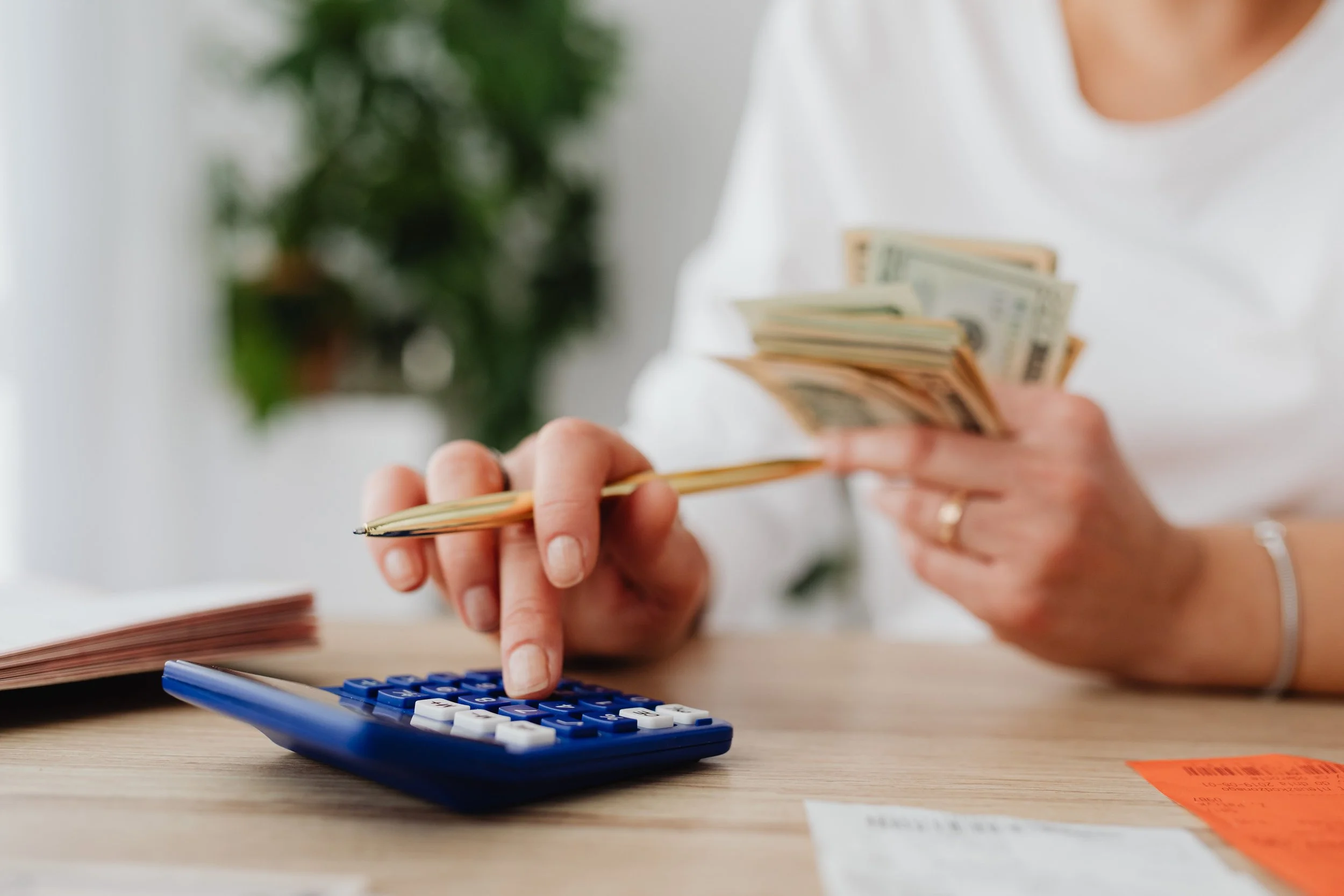
Instead of focusing only on a down-payment percentage, divide your available cash into three categories.
1. Purchase funds
This category includes your down payment, earnest money deposit and closing-related funds. Some of the earnest money may later be credited toward the purchase, but buyers must be prepared to provide it when required by the contract.
2. Transaction expenses
Budget separately for inspections, appraisal-related expenses, prepaid property taxes, homeowners insurance, title-related charges and moving costs. The exact amounts will depend on the home, mortgage and negotiated contract terms.
Insurance deserves particular attention in Florida. Before making an offer, ask for preliminary insurance estimates and determine whether the home’s age, roof, electrical system, plumbing or flood-zone designation could affect coverage.
3. Post-closing reserves
Keep funds available for repairs, maintenance and emergencies. The reserve amount should reflect the home’s age and condition rather than relying on a generic percentage.
For example, a newer condominium may have fewer immediate exterior-maintenance responsibilities, but it could carry association dues or assessments. An older detached home may offer more space and control while requiring a larger repair reserve.
This three-part approach helps prevent buyers from becoming “house rich and cash poor.”
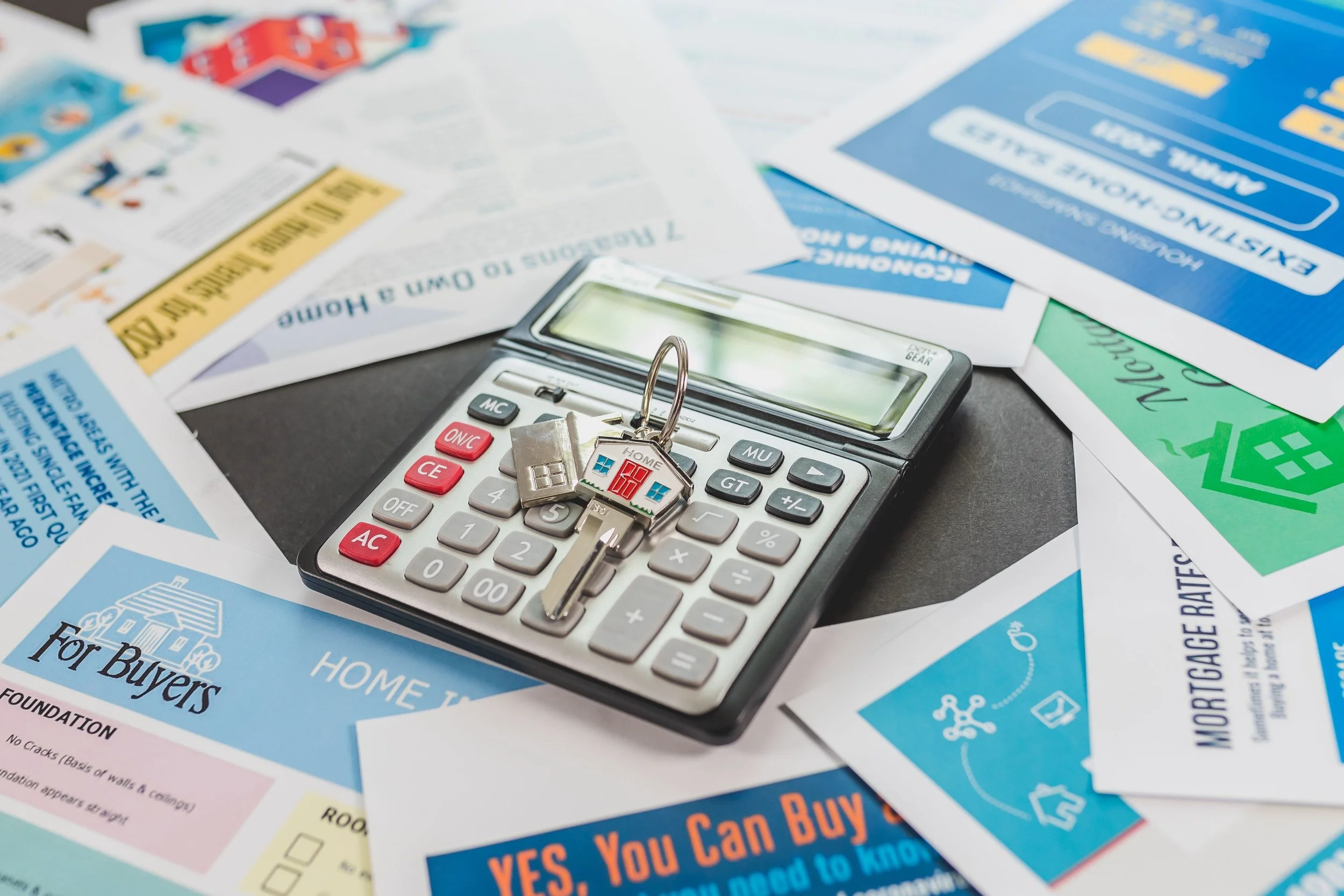
The down payment is only one part of the cash needed for a successful home purchase.
How To Decide How Much To Put Down
Before selecting a down-payment amount, ask a lender to prepare side-by-side estimates for at least three scenarios. For example, compare 3% or 3.5%, 5% and 10% down.
Each estimate should show:
Estimated cash required at closing
Interest rate and annual percentage rate
Principal-and-interest payment
Mortgage insurance
Estimated property taxes and homeowners insurance
Association dues, when applicable
Total monthly housing payment
Cash remaining after closing
Do not compare options based only on the advertised mortgage rate. A lower rate is not automatically the least expensive choice when fees, mortgage insurance and cash requirements are different.
Buyers should also consider their expected ownership timeline. Someone planning to remain in the home for many years may evaluate upfront costs differently from a buyer who expects to relocate within a few years.
Frequently Asked Questions About Orlando Down Payments
How much down payment do I need to buy a house in Orlando?
The amount depends on the mortgage program and your qualifications. Some conventional programs may allow 3% down, FHA financing may allow 3.5%, and qualified VA or USDA borrowers may be eligible for no-down-payment financing.
Do first-time Orlando buyers need 20% down?
No. Twenty percent may help a conventional borrower avoid PMI, but it is not a universal requirement. Several mortgage programs allow qualified buyers to purchase with substantially less.
Is there down payment assistance for Orlando buyers?
Eligible first-time buyers purchasing in Orange County may qualify for the county’s Homebuyer Down Payment Assistance Program. Assistance levels are based on household income and size, and homebuyer education is required.
Can family members help with the down payment?
Certain mortgage programs permit qualified gift funds, although documentation and eligible-donor rules vary. FHA guidance, for example, recognizes gifts and grants among the potential sources for a borrower’s required investment. Buyers should disclose planned gift funds to their lender early.
Is it better to make a 5% or 20% down payment?
Neither option is automatically better. A 20% down payment can reduce the loan and may eliminate conventional PMI. A 5% down payment preserves more cash but generally creates a larger monthly payment. The better choice is the one that provides an affordable payment while leaving sufficient emergency reserves.
The Bottom Line for Orlando Homebuyers
Falling national down payments are an encouraging sign for people who assumed homeownership was out of reach. The latest data does not mean Orlando homes are inexpensive, nor does it mean buyers should stretch their finances to purchase immediately.
It means the 20% down-payment myth should not prevent someone from exploring their options.
With conventional financing starting as low as 3% for some borrowers, FHA financing at 3.5%, zero-down programs for qualified buyers and substantial Orange County assistance for eligible households, the amount needed to purchase an Orlando home may be lower than expected.
The best first step is to speak with a knowledgeable local real estate professional and a licensed mortgage lender. Ask them to evaluate several loan programs, investigate assistance before you begin making offers and build a budget that protects both your monthly cash flow and your savings after closing.
A successful purchase is not about making the biggest down payment possible. It is about choosing a home and financing plan you can comfortably sustain.
This article is for general educational purposes and does not constitute mortgage, legal, tax or financial advice. Program rules, funding and eligibility requirements may change. Buyers should verify current terms with the appropriate agency and a licensed mortgage professional.