Why the Central Florida Housing Market Is More Resilient Than the Headlines Suggest
Why Central Florida’s Housing Market Is Still Strong
Explore why the Central Florida housing market remains resilient in 2026, with ZIP-code trends, buyer leverage, home equity, inventory, and local risks.
Anyone following real estate news has seen the unsettling headlines: mortgage rates remain elevated, homes take longer to sell, buyers are negotiating again, and prices have softened in several Florida communities.
Those developments are real, but they do not automatically mean the Central Florida housing market is collapsing.
A more accurate description is that the market is resetting after several highly unusual years. Buyers now have more time to compare properties, conduct inspections and negotiate. Sellers can no longer assume that every listing will attract multiple offers. Homes that need repairs or are priced above comparable sales may remain available longer.
That is a major change from the buying frenzy of 2020 and 2021, but a slower market is not necessarily a weak market.
Orlando’s typical home value was approximately $375,175 in June 2026, about 2.4% lower than a year earlier, according to Zillow. Homes were still going under contract in a median of about 27 days. Realtor.com classified Orlando as a balanced market in June, with homes selling for an average of about 98% of asking price. The figures suggest moderation and increased buyer leverage—not a disappearance of housing demand.
Today’s Homeowners Have a Much Stronger Financial Cushion
One of the clearest signs of housing-market resilience is the amount of equity homeowners currently hold.
At the end of the first quarter of 2026, American households held approximately $34.9 trillion in real estate equity. Homeowner equity represented about 71.6% of the total value of household real estate. That gives many owners a meaningful financial buffer when they need to sell, relocate, refinance or manage an unexpected expense.
Equity matters because homeowners with substantial ownership stakes are generally less likely to be forced into short sales or distressed transactions when the market slows.
This is one reason today’s market should not be evaluated through a 2008 lens. Many current owners purchased before the latest price peak, made significant down payments or benefited from years of appreciation. Even when a home’s estimated value declines modestly over a 12-month period, its owner may still have considerable equity accumulated over a much longer period.
For Central Florida sellers, that equity can also help fund a down payment on the next property, cover moving expenses or pay for repairs that make a listing more competitive.
Higher Mortgage Rates Are Slowing Activity, Not Eliminating Demand

Affordability remains the market’s most significant obstacle.
The average rate for a 30-year fixed mortgage was 6.55% as of July 16, 2026. Although that was lower than the 6.75% average recorded a year earlier, it was still high enough to affect purchasing power and monthly payments.
Higher borrowing costs have encouraged some buyers to reduce their budgets, consider townhomes instead of detached houses or search farther from downtown Orlando. They have also made many existing owners reluctant to give up mortgages obtained during the years of historically low rates.
Federal Housing Finance Agency research documented how this “lock-in effect” reduced homeowner mobility after mortgage rates increased. A large share of mortgaged owners secured rates below 4% during the pandemic period, giving them a financial incentive to remain in their current homes.
Another key difference from past market cycles is the makeup of today's mortgage landscape. Data from the Federal Housing Finance Agency (FHFA) shows that a majority of homeowners are still locked into mortgage rates below 4%. That means millions of borrowers continue to enjoy historically low monthly payments, reducing the financial pressure to sell even in a changing market (see graph below).
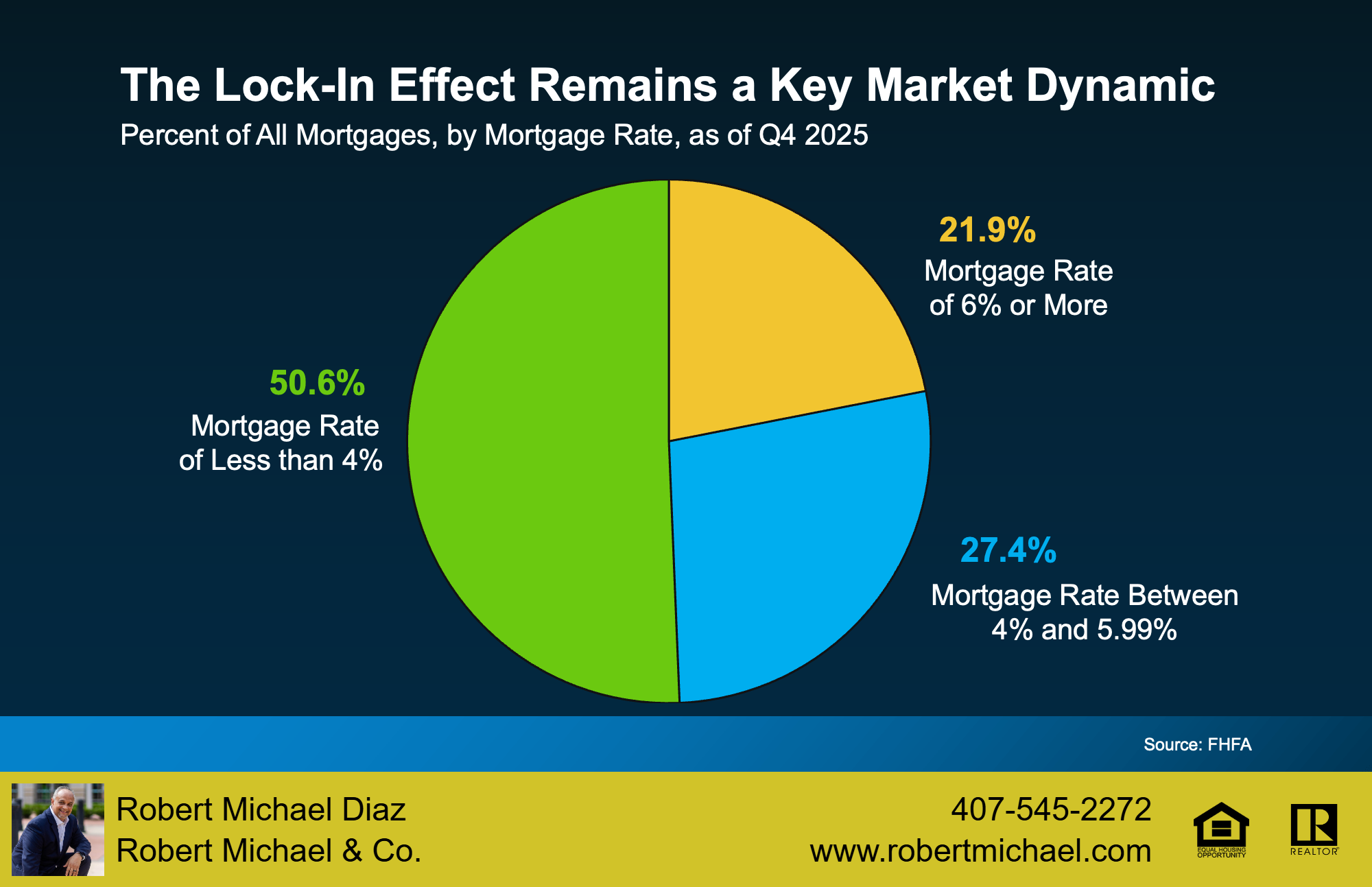
This creates an unusual situation. Demand is constrained by affordability, but the number of owners motivated to sell can also be constrained by their existing mortgage rates. The result is often a slower market with limited turnover rather than a sudden flood of unwanted homes.
Cooling Prices Can Be a Sign of Normalization
Not every price decline is the beginning of a crash.
Nationally, the FHFA House Price Index showed that home prices were 2% higher in April 2026 than in April 2025, even though prices slipped 0.1% from the previous month. That combination illustrates the difference between short-term cooling and a widespread collapse in values.
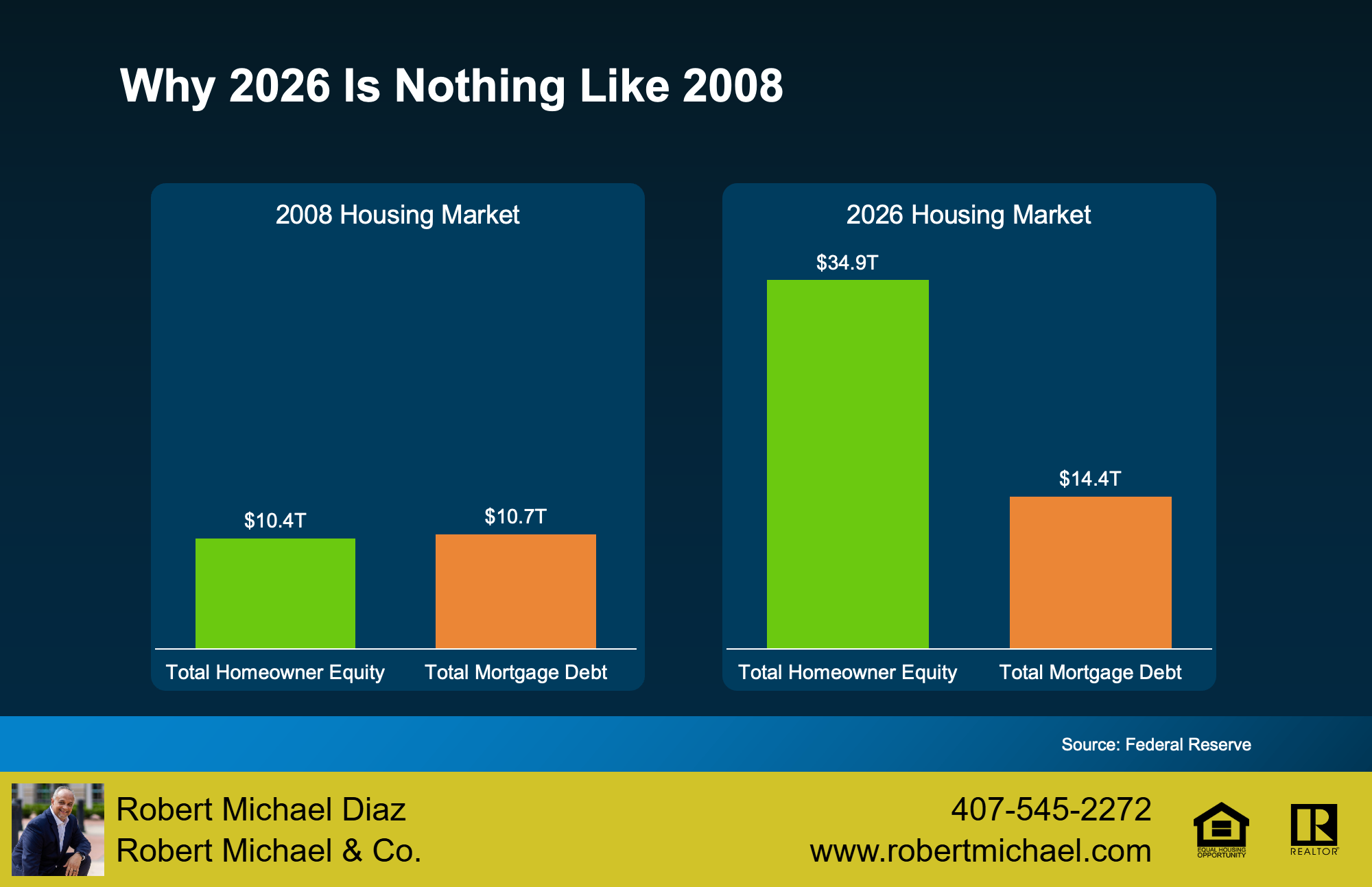
According to Federal Reserve data, homeowner equity and mortgage debt were nearly identical in 2008. That means, if someone hit a rough patch, they had almost nothing to fall back on. That’s what made that crash so bad.
Central Florida is experiencing a similarly uneven pattern. Some ZIP codes are moving quickly. Others have more inventory, longer marketing times and greater room for negotiation. Condominiums, newly constructed homes, luxury properties and entry-level detached homes can behave very differently—even when they are only a few miles apart.
That is why a citywide median or average cannot fully describe the Orlando real estate market. Buyers and sellers need to examine recent sales within the specific ZIP code, neighborhood, property type and price range involved.
Central Florida ZIP-Code Housing Snapshot
The following chart compares Zillow’s typical home values in selected Central Florida ZIP codes. Figures are ZIP-wide estimates through June 30, 2026 and should not be confused with the price of every property or with a professional comparative market analysis.
| ZIP Code | General Area | Typical Home Value | Median Days to Pending |
|---|---|---|---|
| 32811 | West Orlando | $192,590 | 49 days |
| 33803 | Lakeland | $291,039 | 26 days |
| 32714 | Altamonte Springs | $302,398 | 30 days |
| 32837 | South Orlando | $412,531 | 28 days |
| 32803 | Central Orlando | $476,145 | 19 days |
| 32827 | Lake Nona Area | $644,543 | 40 days |
Source: Zillow market data through June 30, 2026. Values are ZIP-wide estimates.
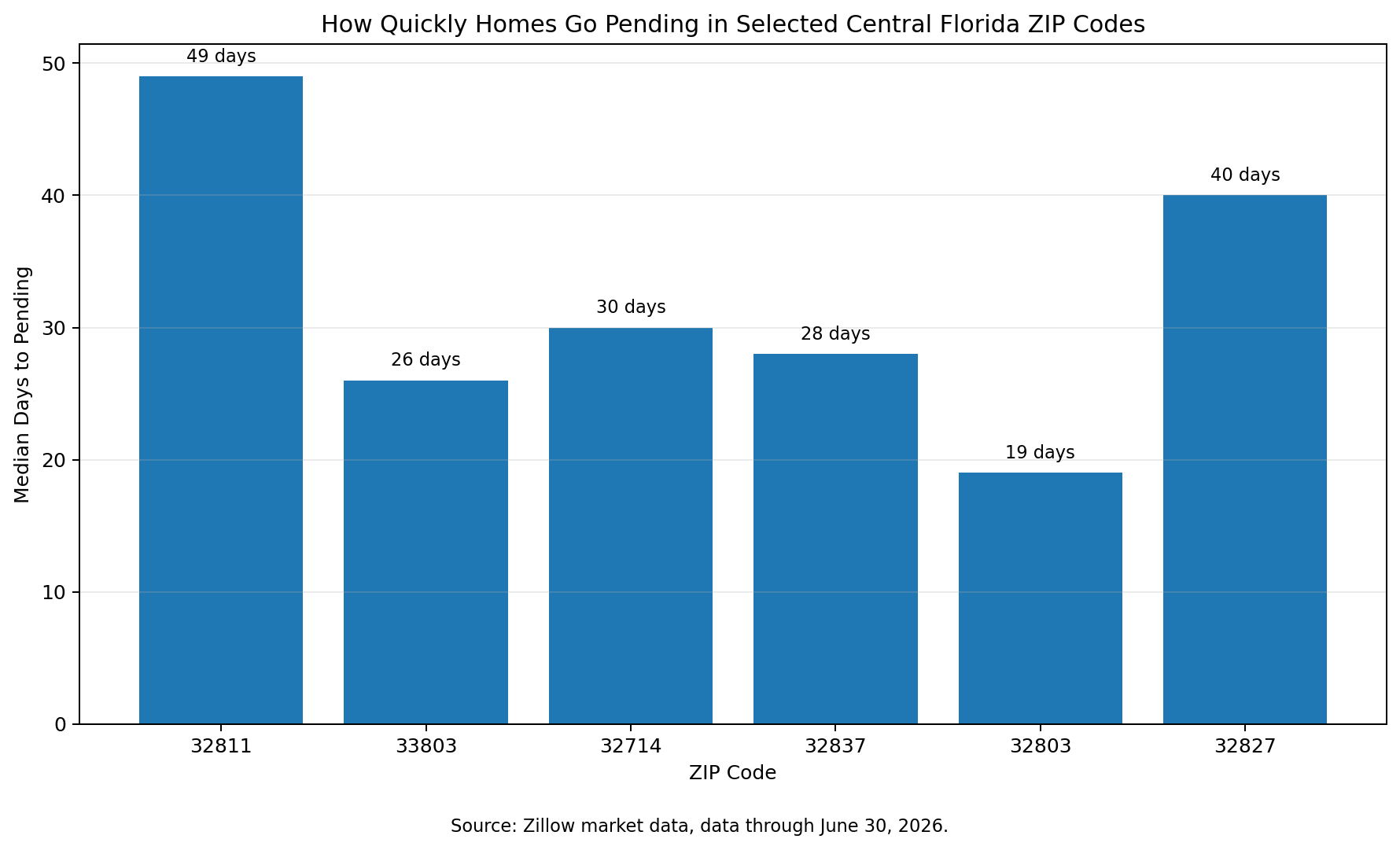
The difference between these ZIP codes demonstrates why there is no single Central Florida market. In June 2026, ZIP code 32803 had a typical value of about $476,145 and homes went pending in approximately 19 days. In 32827, the typical value was higher at roughly $644,543, but the median time to pending was approximately 40 days.
ZIP code 32837 had a typical value of about $412,531 and a median of 28 days to pending. Altamonte Springs ZIP code 32714 was closer to $302,398, while Lakeland ZIP code 33803 was approximately $291,039.
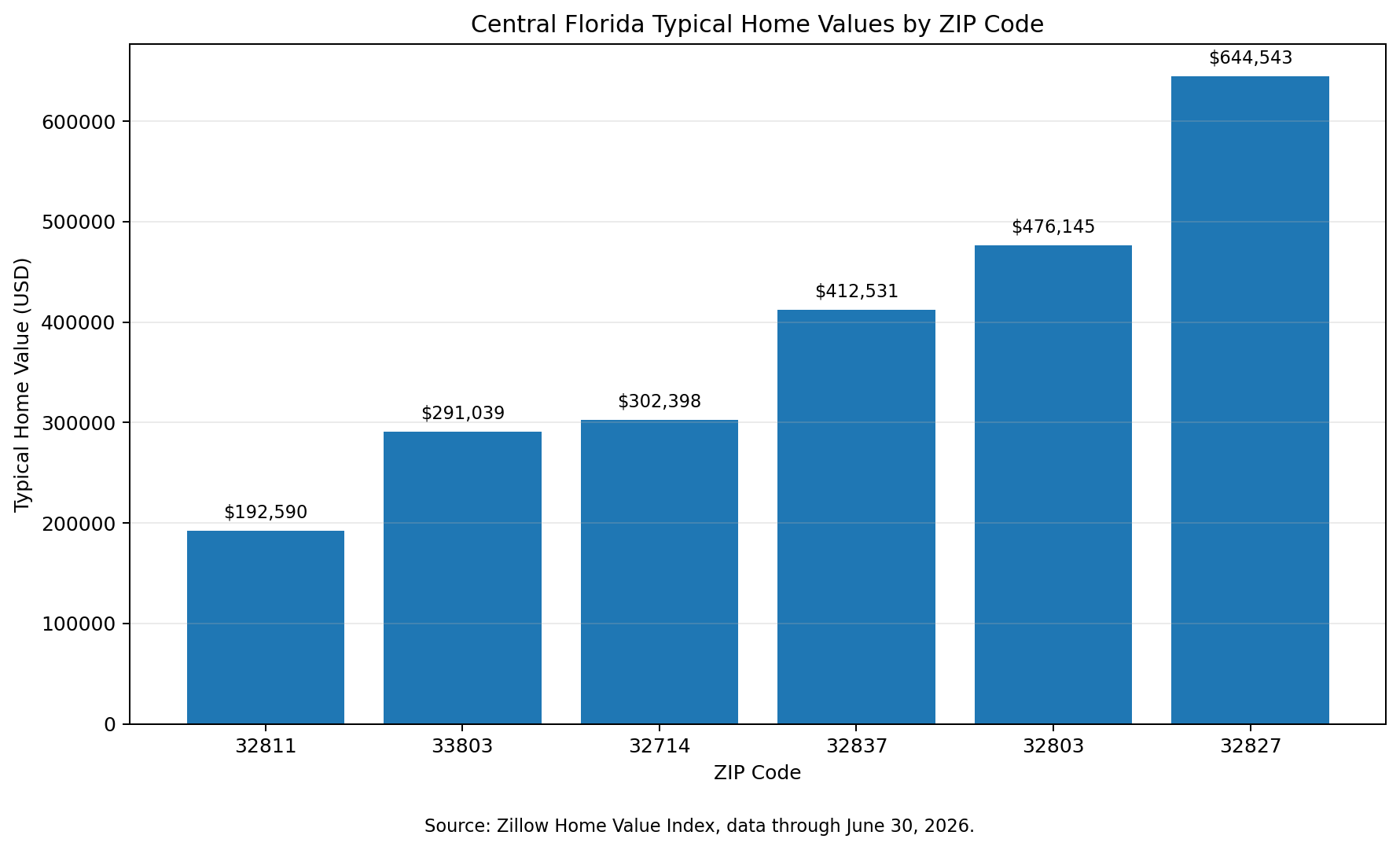
ZIP code 32811 had a substantially lower ZIP-wide typical value of approximately $192,590 and a longer median time to pending. That figure may partly reflect the area’s mix of condominiums, attached housing and smaller properties, so buyers should not interpret it as the expected price of every detached home in the ZIP code.
At the higher end, Baldwin Park ZIP code 32814 had a typical value of approximately $769,930 in May 2026. This illustrates the price premium buyers may encounter in established, amenity-rich communities near central Orlando.
Some Central Florida Homes Are Still Moving Quickly
Average market time can hide the speed of the most desirable listings.
A renovated home with a newer roof, competitive insurance profile and realistic price may receive attention quickly. A similar property with an aging roof, visible deferred maintenance, an ambitious asking price or an expensive homeowners association may sit on the market much longer.
This creates a market in which both of the following statements can be true:
A buyer may have significant negotiating power on a home that has been listed for 60 days.
A well-presented home in a sought-after neighborhood may attract multiple offers during its first week.
That is not a contradiction. It is a selective market that rewards accurate pricing and careful property evaluation.
Population Growth Continues to Support Long-Term Housing Demand
Central Florida continues to attract new residents.
The Orlando–Kissimmee–Sanford metropolitan area added an estimated 37,690 residents between July 2024 and July 2025, bringing its population to approximately 2.96 million. It ranked among the 10 U.S. metropolitan areas with the largest numerical population gains during that period. The Lakeland–Winter Haven metro area also grew by approximately 2.7%, placing it among the country’s fastest-growing metros by percentage.
The region also has major education and employment anchors. The University of Central Florida enrolls more than 70,000 students and maintains facilities in East Orlando, downtown Orlando and Lake Nona. The Orlando metropolitan labor force exceeded 1.5 million people in May 2026.
Population growth does not guarantee that every home will appreciate every year. It does, however, create an ongoing need for housing across multiple categories, including starter homes, rentals, move-up properties, senior housing and new construction.
Buyers Have More Leverage—But Due Diligence Matters More
For buyers, the current Central Florida housing market provides opportunities that were difficult to find during the pandemic-era bidding wars.
Depending on the listing, buyers may be able to negotiate closing-cost assistance, interest-rate buydowns, repair credits, appliance replacements or a lower purchase price. New-home builders may offer additional incentives because they need to sell available inventory and maintain construction schedules.
The strongest offer is not always the one with the highest price. A well-structured offer may account for the buyer’s total monthly cost, including:
Mortgage principal and interest
Property taxes
Homeowners and flood insurance
HOA or community development district fees
Condominium assessments
Expected roof, air-conditioning and plumbing expenses
Insurance and property condition deserve particular attention in Florida. Before the inspection period expires, buyers should obtain insurance estimates, review available permits, examine the roof’s age and condition, and confirm whether the property is in a flood zone.
Buyers comparing Central Florida homes for sale should also examine commute times and future development. A lower-priced home in Polk, Lake or Osceola County may offer more space, but transportation costs and daily travel can offset part of the purchase-price savings.
Sellers Need a More Strategic Approach
Selling a home in Central Florida now requires more preparation than it did when inventory was exceptionally limited.
Buyers can compare more properties and are less willing to overlook obvious defects. A seller who prices a home based on a neighbor’s 2022 sale may struggle if newer comparable properties offer updated roofs, lower fees or builder incentives.
Successful sellers should study the most recent competing listings as well as closed sales. Active listings reveal what buyers can choose today. Pending sales show which prices are attracting offers. Expired and withdrawn listings reveal what the market has rejected.
Presentation also matters. Clean landscaping, bright photography, accurate room descriptions and documented improvements can help a property stand out. Larger repairs are not always necessary, but unresolved insurance problems or visible maintenance issues may dramatically reduce the buyer pool.
Foreclosure Activity Is a Risk to Monitor, Not Ignore
A balanced assessment of the Florida housing market should acknowledge that foreclosure activity has increased.
ATTOM reported that U.S. foreclosure filings rose 21% year over year during the first half of 2026. Nationwide, approximately 0.16% of housing units received a filing. Florida’s rate was higher at approximately 0.27%, while the Lakeland metropolitan area recorded a 0.48% rate—among the highest of the metropolitan areas included in the report.
Another key difference from past market cycles is the makeup of today's mortgage landscape. Data from the Federal Housing Finance Agency (FHFA) shows that a majority of homeowners are still locked into mortgage rates below 4%. That means millions of borrowers continue to enjoy historically low monthly payments, reducing the financial pressure to sell even in a changing market (see graph below).
Those increases deserve attention, particularly in communities where homeowners face rising insurance, association or maintenance costs. However, the figures still represent a relatively small percentage of the overall housing stock. They indicate financial pressure and normalization in distressed-property activity, but they do not by themselves establish that Central Florida is experiencing a 2008-style collapse.
Local conditions should be evaluated ZIP by ZIP and property type by property type.
What the Market Means for Your Next Move
The Central Florida housing market is neither the frantic seller’s market of 2021 nor the distressed market many buyers have been waiting for.
It is a more balanced and demanding environment.
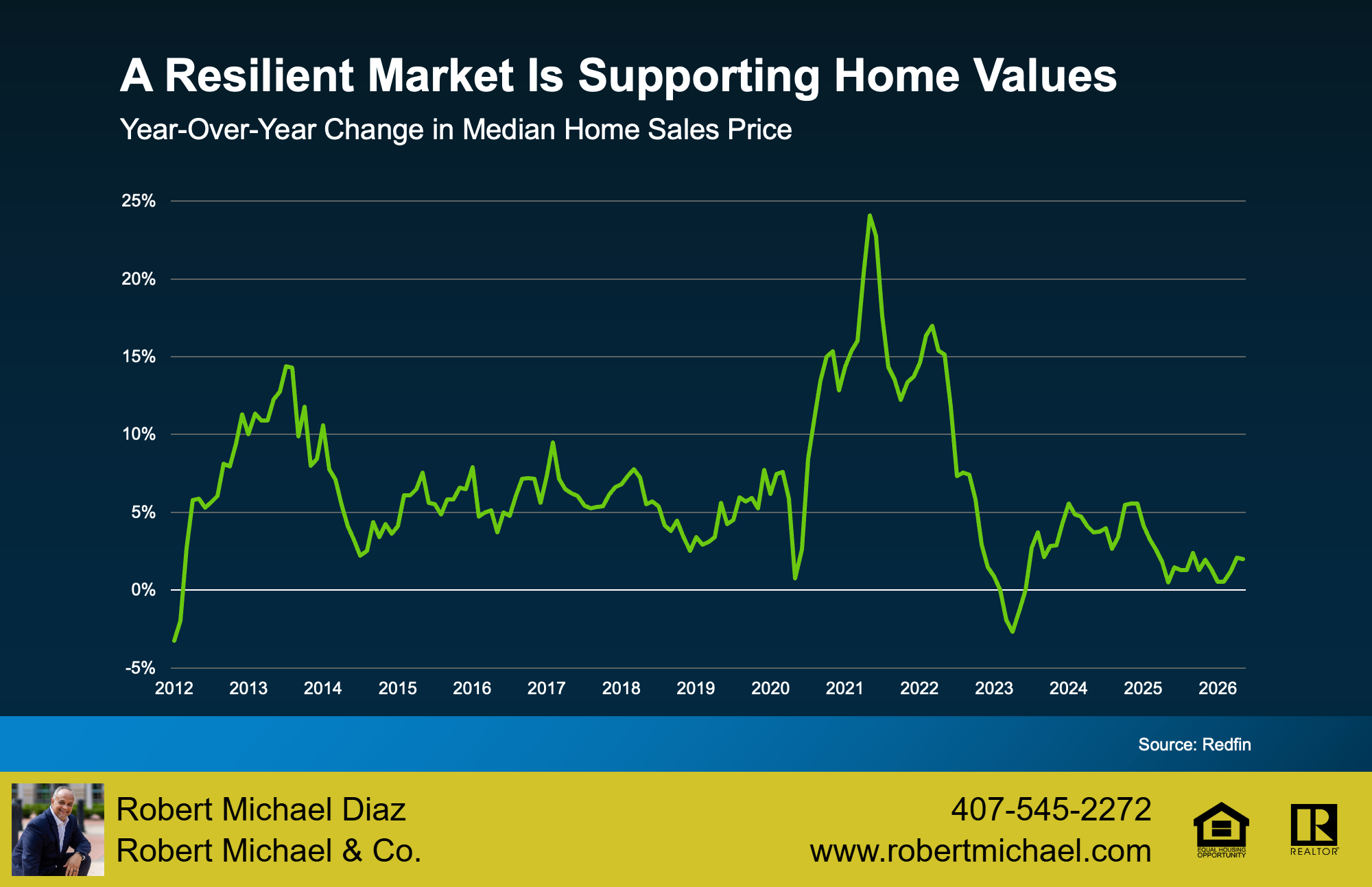
The moderation we're seeing in today's housing market reflects a return to more balanced conditions rather than the start of a major downturn. As buyers and sellers adjust after several years of unusually rapid price growth and limited inventory, the market is gradually finding a healthier pace.
That perspective is echoed by Redfin Chief Economist Daryl Fairweather, who notes:
"We're in the middle of a long-term housing market correction, not a housing market crash. After the pandemic-era frenzy sent prices soaring and inventory to historic lows, the market needed a reset."
Buyers have more choices, more negotiating room and more time to complete due diligence. Sellers can still achieve strong results, but pricing, condition and marketing have become more important. Homeowners generally retain substantial equity, while continued population growth supports long-term housing demand.
The greatest mistake may be making a decision based solely on a national headline.
A buyer considering a condominium in 32811 faces a different market than someone searching for a detached home in 32827. A seller in 32803 should not use a countywide average as a substitute for recent neighborhood sales. An investor looking in Lakeland should examine both population growth and the area’s elevated foreclosure activity.
Real estate is local, and in Central Florida it can be hyperlocal—sometimes changing from one community entrance to the next.
For a personalized analysis, contact Robert Michael & Co. Real Estate Team for current listings, recent comparable sales and a ZIP-code-specific strategy for buying or selling a home in Central Florida.
Frequently Asked Questions
Is Central Florida a buyer’s market in 2026?
Conditions vary by location and property type, but buyers generally have more leverage than they did during the pandemic-era market. Realtor.com characterized Orlando as balanced in June 2026, while many homes sold below their original asking prices.
Are Orlando home prices falling?
Some measures show modest year-over-year declines. Zillow reported that Orlando’s typical home value was down approximately 2.4% in June 2026. Other ZIP codes were nearly flat, while national FHFA data still showed positive annual price growth. The market is uneven rather than uniformly rising or falling.
Which Central Florida ZIP codes may offer lower entry prices?
Among the examples reviewed, ZIP codes 32811, 33803 and 32714 had lower typical values than 32803, 32837 and 32827. Buyers should compare property types carefully because ZIP-wide values can be affected by the number of condominiums, townhomes and smaller residences in an area.
Should sellers wait for mortgage rates to fall?
Future mortgage-rate movements cannot be predicted with certainty. Sellers should base their decision on equity, relocation needs, carrying costs and local competition rather than waiting for a specific rate. A lower future rate could improve demand, but it could also attract additional sellers and increase listing competition.